



June 7, 2023
By CJ Stevenson, Program Officer
There is a judge who holds court on the fourth floor of the George L. Allen Sr. Courts Building in the West End of Dallas. This is a special court. You won’t appear in front of Judge Delia Gonzales for a speeding ticket or similar offense. Those that enter her court room are seeking permanency amid a life in perceived crisis and chaos. Sibling groups and youth who have found themselves wading through the child welfare system in Dallas County having bounced around foster homes and other temporary shelter for a number of years with no place to call home.
The Dallas County Child Protection and Permanency Court (DCCPPC) was established in 2019 with a mission to ensure all referred children age birth to 18 under Texas Department of Family and Protective Services (DFPS) conservatorship are heard and find a permanent forever home with positive results. Referrals are very specific to those children who have faced abuse and neglect, abandonment from parents, and/or a host of other qualifying reasons that qualify them for this specialty court’s docket.
The Dallas Permanency Court is only the second court of this type in the nation, and is modeled after a similar court in Houston that specializes in finding permanency for children and youth in the long-term care of DFPS. The Permanency Court was established because of the sheer volume of children in the system, which meant that it was taking four to five years for children and youth to exit the system into a permanent home. Judge Gonzales, who presides over the Dallas Permanency Court, identifies barriers to children’s stability and brings an individualized approach to every child and family.
Without Judge Gonzales and this specialty court, children in permanent state conservatorship would not receive the same level of attention and care due to the volume of child abuse and neglect cases.
Family courts are spaces that specifically adjudicate in matters involving children and families, specifically custody disputes, parental rights, abuse and neglect, child welfare. Family courts are specialized settings comparatively with other courts in the judicial system. Each judge has his or her own personality and runs his or her court in a unique manner, but they all conform to the same pattern of proceedings. . Everyone – attorneys, CPS case workers, CASAs, family members and others – cram into a tiny holding space within the courtroom. There is a strange and silent chaos with prosecutors and guardian ad litems silently slipping between court rooms, motioning to clients to chat outside, the swinging doors of the courtroom constantly admitting and excusing groups of 10 at a time.
Despite it being family court with children’s livelihoods being the topic of discussion, children and youth are rarely in attendance. The courtroom is full of adults – oftentimes unrelated to the child – who are charged with making decisions that impact the child in the most intimate way: who and how they will be cared for.
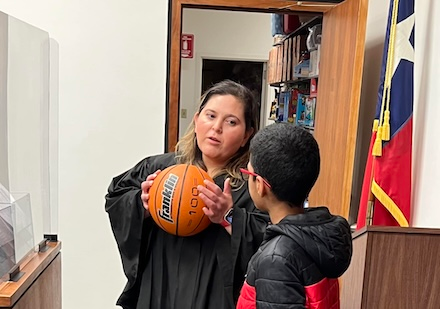
This permanency court under Judge Gonzales operates differently. It enlists a special judge – the same judge – with a big smile who is able to take the time required to get to know the children entrusted in the state’s care. A constant in a world that is filled with CPS turn-over, numerous foster families, and untold trauma.
Judge Delia Gonzales, who spent 15 years as a guardian ad litem before her judgeship, runs her courtroom in an almost unheard of manner. She organizes her docket in 30-minute blocks allowing her to allocate her entire self to the children in front of her. No one is permitted into the courtroom until their case is called, which allows for a more pleasant experience for all and an unheard of level of privacy for the families involved.
A friendly face greets all case party members in a bright waiting room that packs snacks, toys, and an area similar to a rainbow room where youth and families can access clothing, toiletries and other essential items. When it’s time, Judge Gonzales welcomes the group into her teddy bear filled courtroom. She keeps the mood light, inquires with the children how they’re doing, what they learned in school, and other small talk that coaxes out personalities of even the shyest of children or guarded teens. For the adolescents, she asks pointed questions about behavior in school, grades, friends and the like. Judge Gonzales isn’t nosey, her inquisitiveness comes from a place of deep care and a desire to walk alongside the teens that stand in front of her to help them sort out their lives. She views herself as their advocate, a job she can only do if the teenager is willing be to vulnerable – another reason she keeps the court audience as minimal as possible.
Rees-Jones Foundation

Leave a Reply to A WordPress Commenter Cancel reply